Quick Summary
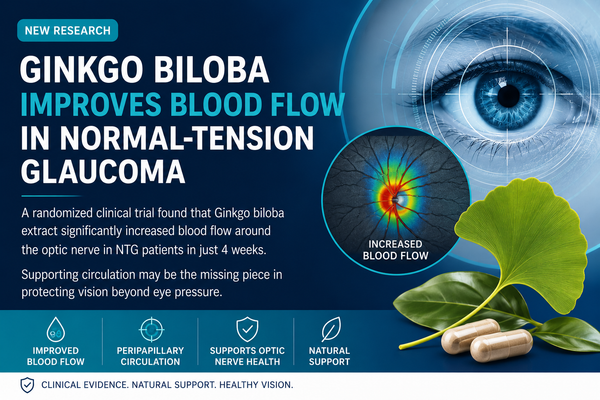
A clinical study from researchers at Indiana University found that a specialized antioxidant supplement containing Ginkgo biloba significantly improved blood flow to the retina and optic nerve in patients with open-angle glaucoma after just one month of use.
While the supplement did not lower eye pressure or prove that vision loss can be prevented, the findings suggest that improving blood circulation to the eye may support the health of vulnerable retinal nerve cells and could become an important part of future glaucoma management.
Key Takeaways
- A one-month Ginkgo biloba and antioxidant supplement improved blood flow in multiple blood vessels supplying the eye.
- The study included patients with open-angle glaucoma, the most common form of glaucoma.
- Researchers observed increased retinal capillary circulation and reduced vascular resistance.
- Eye pressure (IOP) did not change, suggesting the benefits were independent of pressure lowering.
- The supplement contained Ginkgo biloba along with vitamins, omega-3 fatty acids, bilberry extract, CoQ10, alpha-lipoic acid, NAC, grape seed extract, and other antioxidants.
- Improved blood flow may help retinal ganglion cells receive more oxygen and nutrients.
- The study did not determine whether these changes slow glaucoma progression or preserve vision.
Why This Study Matters
For decades, glaucoma treatment has focused almost exclusively on lowering eye pressure. While reducing intraocular pressure remains the cornerstone of glaucoma care, many patients continue to lose vision even when their pressure appears well controlled.
This has led scientists to investigate another possible contributor to glaucoma: poor blood circulation to the optic nerve and retina.
Think of the optic nerve as an electrical cable connecting the eye to the brain. Just as a cable requires a steady supply of electricity to function properly, nerve cells require a continuous supply of oxygen and nutrients delivered by blood vessels.
When blood flow becomes inadequate, retinal ganglion cells—the very cells damaged in glaucoma—may become more vulnerable to injury.
This study explored whether a nutritional approach could improve blood flow to these critical tissues.
The Study Design
Researchers studied 45 adults with open-angle glaucoma.
To ensure reliable results, the study was designed to be:
- Randomized: Participants were randomly assigned to receive either the supplement or a placebo first.
- Double-Blind: Neither the participants nor the researchers knew who was receiving the supplement during each phase.
- Placebo-Controlled: The supplement was compared with an inactive placebo.
- Cross-Over: Every participant received both the supplement and the placebo at different times, allowing researchers to compare results within the same person.
Participants took each treatment for one month, with a three-week break in between to allow the first treatment to clear from their system. Of the 45 participants who started the study, 42 completed it.
What Was in the Antioxidant Formula?
The supplement evaluated was a comprehensive formulation designed to support optic nerve health.
Key Ingredients
- Ginkgo biloba extract (120 mg)
- Bilberry extract (115 mg)
- Vitamin C (250 mg)
- Vitamin E (30 IU)
- Vitamin B6
- Folate
- Vitamin B12
- Magnesium
- Taurine
- N-Acetylcysteine (NAC)
- Alpha-lipoic acid
- Coenzyme Q10 (CoQ10)
- Grape seed extract
- Quercetin
- Omega-3 fatty acids
- Flaxseed oil
Many of these ingredients are known antioxidants, meaning they help neutralize harmful molecules called free radicals that can damage cells through oxidative stress.
Why Ginkgo Biloba Attracted Particular Interest
Among all ingredients, Ginkgo biloba has received the most scientific attention in glaucoma research.
How Ginkgo May Help
Ginkgo contains flavonoids and terpene lactones that may:
- Improve blood vessel function
- Increase blood flow
- Reduce oxidative stress
- Protect nerve cells from damage
- Improve circulation in small blood vessels
Previous studies have suggested that Ginkgo may improve ocular blood flow and potentially slow progression in some glaucoma patients, particularly those with normal-tension glaucoma.
This study builds on that body of evidence.
How Researchers Measured Blood Flow
One of the strengths of this study was the use of advanced, non-invasive imaging techniques.
Color Doppler Imaging (CDI)
This ultrasound-based technology measures blood flow within major arteries supplying the eye.
Researchers evaluated:
Peak Systolic Velocity (PSV)
The maximum speed of blood flow during a heartbeat.
Why it matters: Higher PSV generally indicates stronger blood delivery through the artery.
End Diastolic Velocity (EDV)
The speed of blood flow between heartbeats.
Why it matters: Higher EDV suggests blood continues flowing smoothly even when the heart is resting.
Resistive Index (RI)
A measure of resistance within blood vessels.
Why it matters: Lower RI indicates blood encounters less resistance and can flow more easily.
Heidelberg Retinal Flowmetry (HRF)
This laser-based technology evaluates circulation within the tiny capillaries of the retina.
Researchers measured:
Mean Blood Flow
The overall amount of blood moving through retinal capillaries.
Active vs. Non-Active Capillaries
This identifies how many small vessels are actively carrying blood.
Why it matters: More active capillaries mean a greater portion of retinal tissue is receiving oxygen and nutrients.
What Did the Researchers Find?
The results were encouraging.
Improved Blood Flow in Major Eye Arteries
Compared with placebo, antioxidant supplementation significantly increased blood flow velocities in all four major blood vessels supplying the eye.
Researchers observed:
- Increased peak systolic velocity (PSV)
- Increased end diastolic velocity (EDV)
- Reduced vascular resistance (RI)
In practical terms, blood moved faster and more efficiently through vessels serving the retina and optic nerve.
Better Retinal Microcirculation
The supplement also improved blood flow within the retina itself.
Researchers found:
- Up to an 8.1% increase in retinal capillary blood flow
- Up to a 15.9% increase in active capillary density
- Fewer dormant retinal capillaries
This suggests that more of the retina's microscopic blood vessels were actively supplying oxygen and nutrients after supplementation.
No Change in Eye Pressure
Importantly, the supplement did not significantly change:
- Intraocular pressure (IOP)
- Ocular perfusion pressure (OPP)
This indicates the improvements in circulation occurred independently of pressure reduction.
Why These Findings Matter for Glaucoma Patients
Glaucoma is increasingly viewed as more than simply a disease of elevated eye pressure.
Researchers now recognize that many patients also have vascular abnormalities, including:
- Reduced retinal blood flow
- Reduced optic nerve circulation
- Impaired blood vessel regulation
- Lower ocular perfusion
Poor circulation may contribute to retinal ganglion cell damage and accelerate vision loss.
The findings from this study suggest that nutritional strategies aimed at improving blood flow may help create a healthier environment for these vulnerable nerve cells.
An easy way to think about it is this:
Lowering eye pressure removes stress from the optic nerve.
Improving blood flow may improve the optic nerve's supply of oxygen and nutrients.
Both approaches could potentially work together.
Important Limitations
Despite the positive findings, several limitations should be kept in mind.
The Study Was Short
Participants were followed for only one month during each treatment phase.
Longer studies are needed.
Blood Flow Is Not the Same as Vision Preservation
The study demonstrated improved circulation, but it did not show:
- Slower visual field loss
- Reduced glaucoma progression
- Better long-term vision outcomes
Multiple Ingredients Were Tested Together
Because the supplement contained many nutrients, it is impossible to determine how much of the benefit came specifically from Ginkgo biloba versus the other antioxidants.
No Healthy Control Group
Researchers only studied glaucoma patients, making comparisons with healthy individuals impossible.
The Bottom Line
This well-designed clinical trial found that a specialized antioxidant supplement containing Ginkgo biloba significantly improved blood flow to the retina and optic nerve in patients with open-angle glaucoma after one month of use.
The findings add to growing evidence that vascular health may play an important role in glaucoma. Although the study did not prove that supplements can prevent vision loss or slow disease progression, it demonstrated measurable improvements in ocular circulation—an area of increasing interest among glaucoma researchers.
Future long-term studies will determine whether these improvements in blood flow ultimately translate into better protection of vision.
Study Reference
Harris A, Gross J, Moore N, Do T, Huang A, Gama W, Siesky B. The effects of antioxidants on ocular blood flow in patients with glaucoma. Acta Ophthalmol. 2018 Mar;96(2):e237-e241. doi: 10.1111/aos.13530. Epub 2017 Aug 3. PMID: 28772005.
Science-informed glaucoma supplement with 500 mg Nicotinamide & 120 mg Ginkgo Biloba. Be first to know when it's available.