Summary
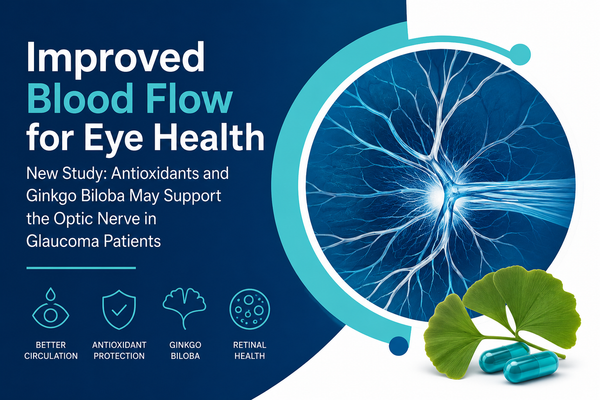
A new clinical study suggests that Ginkgo biloba, a popular herbal supplement long known for its antioxidant and circulation-enhancing properties, may improve blood vessel density around the optic nerve after just four weeks of use.
Using advanced retinal imaging technology, researchers found measurable improvements in the tiny blood vessels that nourish the optic nerve. While the study was conducted in healthy young adults—not glaucoma patients—the findings add to growing evidence that Ginkgo biloba could play a supportive role in protecting vision and optic nerve health.
Key Takeaways
- A four-week course of Ginkgo biloba increased blood vessel density around the optic nerve.
- The study used advanced optical coherence tomography angiography (OCTA) to visualize microscopic retinal blood vessels.
- Improvements were seen specifically in the radial peripapillary capillaries (RPCs), the vessels that supply the optic nerve head.
- No significant side effects were reported.
- The study was conducted in healthy volunteers, not glaucoma patients.
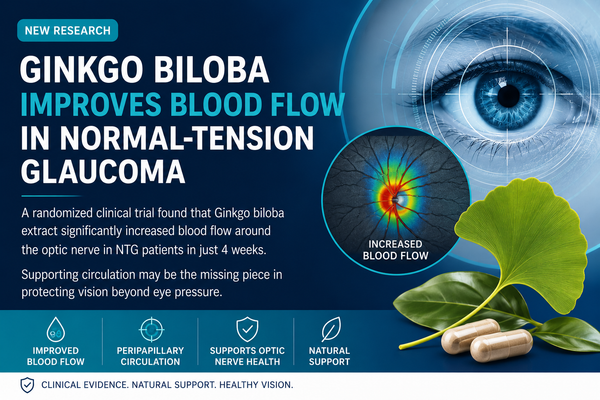
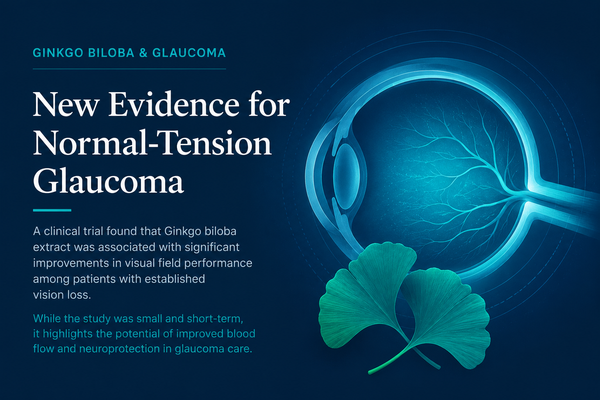
- Previous research suggests Ginkgo biloba may improve visual field outcomes and ocular blood flow in normal-tension glaucoma.
- Larger placebo-controlled studies are needed before definitive conclusions can be made.
Why This Study Matters
Glaucoma is often thought of as a disease caused by elevated eye pressure. However, scientists increasingly recognize that reduced blood flow and oxidative stress may also contribute to optic nerve damage.
The optic nerve functions like a high-speed cable connecting the eye to the brain. Like any living tissue, it requires a constant supply of oxygen and nutrients. When blood circulation becomes impaired, nerve cells may become more vulnerable to injury.
Ginkgo biloba has attracted attention because it appears to offer two potential benefits:
- Improved blood circulation
- Antioxidant protection against cellular damage
If these effects help preserve optic nerve health, Ginkgo biloba could potentially complement traditional glaucoma therapies.
What Is Ginkgo Biloba?
Ginkgo biloba is derived from the leaves of one of the world's oldest tree species, often called the "maidenhair tree."
Its extract contains several biologically active compounds, including:
- Flavonoids
- Terpene lactones
- Ginkgolides
- Bilobalide
These compounds have been shown to:
- Reduce oxidative stress
- Improve microcirculation
- Reduce platelet aggregation
- Support blood vessel function
Because of these properties, Ginkgo has been studied for conditions ranging from cognitive decline to vascular disease and glaucoma.
Study Design and Methodology
Who Participated?
Researchers recruited 60 healthy volunteers between 18 and 30 years old.
Participants:
- Had no eye disease
- Had no systemic illnesses
- Were not taking medications or supplements
- Had normal eye examinations
The average age was approximately 21 years.
What Treatment Was Used?
Participants took:
- 120 mg of Ginkgo biloba extract daily
- Once each morning
- For four consecutive weeks
The extract contained:
- 27% ginkgo flavone glycosides
- 6.8% terpene lactones
How Were Changes Measured?
Researchers evaluated participants before and after supplementation using:
- Optical Coherence Tomography (OCT)
- Optical Coherence Tomography Angiography (OCTA)
- Blood pressure measurements
- Eye pressure measurements
All imaging was performed under carefully controlled conditions to ensure accuracy and consistency.
Understanding the Measurements
What Is OCTA?
Optical Coherence Tomography Angiography (OCTA) is a non-invasive imaging technology that allows doctors to see tiny blood vessels inside the retina and optic nerve without injecting dye.
Think of it as an MRI for the eye's circulation system.
OCTA can measure:
- Blood vessel density
- Blood flow patterns
- Capillary structure
- Areas of reduced circulation
This technology has become increasingly important in glaucoma research because it can detect subtle vascular changes before structural damage becomes obvious.
What Are Radial Peripapillary Capillaries (RPCs)?
RPCs are microscopic blood vessels that surround the optic nerve head.
Their role is crucial because they supply oxygen and nutrients to retinal nerve fibers that eventually form the optic nerve.
Damage or reduced circulation in these vessels has been associated with glaucoma progression.
For this reason, many researchers consider RPC health a potential biomarker for optic nerve health.
What Did the Researchers Find?
After four weeks of supplementation, researchers observed statistically significant increases in RPC vessel density in several key regions surrounding the optic nerve.
The largest improvements occurred in:
- Peripapillary region
- Superior quadrant
- Inferior quadrant
- Temporal quadrant
These findings suggest that Ginkgo biloba may improve microvascular circulation in tissues that directly support the optic nerve.
What Did Not Change?
Researchers found no significant changes in:
- Visual acuity
- Eye pressure
- Blood pressure
- Retinal nerve fiber layer thickness
- Macular blood vessel density
- Choroidal thickness
This is not surprising because healthy young adults generally begin with normal vision and healthy optic nerves.
The study was designed to detect vascular changes, not vision improvement.
Why the Findings May Be Important for Glaucoma
The most intriguing aspect of the study is where the changes occurred.
Ginkgo did not increase blood vessel density throughout the retina. Instead, improvements were concentrated around the optic nerve—the very structure damaged in glaucoma.
This observation aligns with earlier studies showing that Ginkgo biloba may:
- Increase ocular blood flow
- Improve blood flow velocity around the optic nerve
- Slow visual field deterioration in some patients with normal-tension glaucoma
- Improve existing visual field defects in certain glaucoma patients
Taken together, these findings strengthen the hypothesis that Ginkgo's benefits may be related to improved optic nerve circulation and protection against oxidative stress.
Possible Mechanisms Behind the Benefits
Researchers believe several biological mechanisms may explain the observed effects.
Improved Blood Vessel Function
Flavonoids in Ginkgo biloba may stimulate the release of substances that relax blood vessels, allowing them to widen and improve circulation.
Reduced Blood Viscosity
Ginkgo may decrease platelet aggregation, helping blood flow more efficiently through tiny capillaries.
Antioxidant Protection
The extract contains potent antioxidants that neutralize free radicals.
Free radicals can damage retinal ganglion cells—the very cells that die in glaucoma.
By reducing oxidative stress, Ginkgo may help create a healthier environment for optic nerve survival.
Limitations of the Study
While encouraging, several limitations should be noted.
Healthy Volunteers Only
The study did not include glaucoma patients.
We cannot assume the same vascular changes would occur in people already experiencing optic nerve damage.
No Placebo Group
Because there was no placebo comparison group, researchers cannot completely rule out other influences.
Short Duration
The study lasted only four weeks.
It remains unclear whether the benefits persist or increase with long-term use.
No Vision Outcomes
The study measured blood vessel changes, not visual improvement.
Whether these vascular changes translate into better vision preservation remains unknown.
Bottom Line
This pilot study provides intriguing evidence that Ginkgo biloba may improve microvascular circulation around the optic nerve, a key structure affected by glaucoma.
Although the research was conducted in healthy volunteers, the findings support a growing body of evidence suggesting that Ginkgo biloba may offer both vascular and antioxidant benefits relevant to glaucoma and other optic nerve disorders.
For glaucoma patients, the study does not prove that Ginkgo prevents vision loss. However, it does provide another piece of scientific evidence supporting further investigation into how targeted nutritional strategies may help protect the optic nerve alongside conventional treatment.
As researchers continue to explore the relationship between blood flow, oxidative stress, and glaucoma progression, Ginkgo biloba remains one of the most promising natural compounds under investigation.
Study Reference
Sabaner MC, Dogan M, Altin SS, Balaman C, Yilmaz C, Omur A, Zeybek I, Palaz M. Ginkgo Biloba affects microvascular morphology: a prospective optical coherence tomography angiography pilot study. Int Ophthalmol. 2021 Mar;41(3):1053-1061. doi: 10.1007/s10792-020-01663-3. Epub 2021 Jan 3. PMID: 33392942.
Science-informed glaucoma supplement with 500 mg Nicotinamide & 120 mg Ginkgo Biloba. Be first to know when it's available.