Summary
For people with normal-tension glaucoma, vision loss can continue even when eye pressure is already well controlled. A new randomized clinical trial suggests that nicotinamide—a form of vitamin B3—may help improve retinal function by supporting the health of nerve cells in the eye.
Researchers found that patients taking nicotinamide experienced measurable improvements in retinal function compared with those taking a placebo, raising hopes that nutritional neuroprotection could become an important complement to traditional glaucoma treatment.
Key Takeaways
- A randomized, placebo-controlled clinical trial evaluated oral nicotinamide (vitamin B3) supplementation in patients with normal-tension glaucoma.
- Participants taking nicotinamide showed significant improvements in retinal function measured by electroretinography.
- Benefits were observed without changes in intraocular pressure (IOP), suggesting a direct neuroprotective effect.
- No serious side effects were reported during the study.
- Traditional visual field measurements did not significantly improve over the short study period.
- Longer-term studies are needed to determine whether nicotinamide can slow glaucoma progression and preserve vision over time.
Why This Study Is Important
Glaucoma is one of the leading causes of irreversible blindness worldwide. Most treatments focus on lowering intraocular pressure (IOP), the only proven way to slow disease progression.
But normal-tension glaucoma (NTG) presents a unique challenge. Patients develop optic nerve damage and vision loss despite having eye pressures that fall within the normal range. This suggests that factors beyond pressure—including impaired energy metabolism, oxidative stress, reduced blood flow, and nerve cell vulnerability—play an important role in the disease.
Scientists have increasingly turned their attention toward neuroprotection: treatments designed to preserve retinal ganglion cells, the nerve cells responsible for transmitting visual information from the eye to the brain.
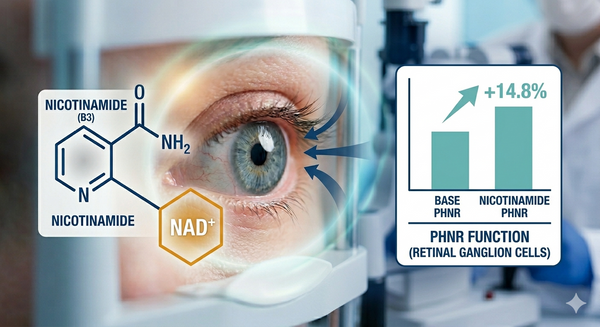
One promising candidate is nicotinamide (vitamin B3), a precursor to nicotinamide adenine dinucleotide (NAD+), a molecule essential for cellular energy production. Previous animal studies and early human trials suggested that boosting NAD+ levels may protect retinal ganglion cells from degeneration.
Study Design
Type of Study
Researchers conducted a:
- Prospective clinical trial
- Double-masked study
- Randomized trial
- Placebo-controlled trial
- Crossover study
The study was conducted in South Korea between September 2022 and March 2024.
Participants
The trial enrolled 53 adults diagnosed with early-to-moderate normal-tension glaucoma.
Participants:
- Had untreated eye pressures of 18 mm Hg or less
- Were already receiving pressure-lowering glaucoma medications
- Had relatively preserved visual function
- Had stable disease management throughout the study period
Forty-six participants completed the trial, and the final retinal function analysis included 31 participants with high-quality electroretinography recordings.
Materials and Methodology
Participants were randomly assigned to receive either:
Nicotinamide Treatment
- 1 gram per day for the first 6 weeks
- 2 grams per day for the following 6 weeks
Placebo
Participants received identical-looking placebo tablets.
After 12 weeks, participants crossed over to the opposite treatment without a washout period, allowing researchers to compare responses within the same individuals.
Throughout the study, researchers measured:
- Visual acuity
- Eye pressure
- Blood pressure
- Visual field performance
- Retinal nerve fiber thickness
- Electroretinography (ERG) responses
- Laboratory safety markers including liver function tests
Understanding the Measurements
What Is Electroretinography (ERG)?
Electroretinography measures the electrical activity generated by cells in the retina when exposed to light.
Think of it as an "EKG for the eye."
Because retinal ganglion cells are damaged in glaucoma, researchers can use ERG to detect subtle changes in retinal function before major vision changes become apparent.
What Is the Photopic Negative Response (PhNR)?
The primary measurement in this study was the Photopic Negative Response (PhNR).
PhNR is a specialized ERG signal that reflects the function of retinal ganglion cells—the very cells damaged by glaucoma.
Higher PhNR amplitudes generally indicate healthier retinal ganglion cell function.
Visual Field Testing
Researchers also evaluated:
Mean Deviation (MD)
Measures overall visual field loss compared with healthy individuals.
Pattern Standard Deviation (PSD)
Measures localized visual field abnormalities.
Visual Field Index (VFI)
Represents the percentage of remaining visual function.
These are standard measures used by glaucoma specialists to monitor disease progression.
Results
Improved Retinal Function
After 12 weeks, patients taking nicotinamide experienced significantly greater improvements in retinal electrical activity than those taking placebo.
Photopic Negative Response (PhNR)
- Nicotinamide group: +3.12 µV
- Placebo group: +1.00 µV
- Statistical significance: p = 0.045
B-Wave Amplitude
- Nicotinamide group: +2.11 µV
- Placebo group: +0.31 µV
- Statistical significance: p = 0.032
These findings indicate improved retinal function among patients receiving nicotinamide supplementation.
Visual Fields Did Not Significantly Improve
Researchers did not find statistically significant improvements in:
- Mean Deviation (MD)
- Pattern Standard Deviation (PSD)
- Visual Field Index (VFI)
Although nicotinamide-treated eyes tended to show more localized improvements in visual field sensitivity, the differences were not large enough to reach statistical significance.
Excellent Safety Profile
No serious adverse events occurred during the trial.
Researchers reported:
- No significant liver toxicity
- No meaningful safety concerns
- High treatment adherence exceeding 90%
The treatment was generally well tolerated even at the higher 2-gram daily dose.
Why These Findings Matter
One of the most intriguing aspects of this study is that retinal function improved without lowering eye pressure.
This suggests that nicotinamide may be working through an entirely different mechanism than traditional glaucoma therapies.
Scientists believe nicotinamide helps replenish NAD+, a molecule essential for mitochondrial energy production. Because retinal ganglion cells have exceptionally high energy demands, boosting cellular energy production may help these cells function more efficiently and resist damage.
For patients with normal-tension glaucoma—where pressure is already relatively low—this could represent a potentially important new treatment strategy.
What Are the Limitations?
Several important limitations should be considered:
Short Duration
The study lasted only 12 weeks per treatment period.
Glaucoma progresses slowly, often over years, making longer follow-up essential.
Small Sample Size
Only 53 participants were enrolled, and some data were excluded because of unreliable testing.
Functional Improvement Does Not Equal Disease Modification
The study demonstrated improved retinal function but did not prove that nicotinamide slows long-term vision loss or prevents blindness.
No Biomarker Confirmation
Researchers did not directly measure blood NAD+ levels to confirm metabolic changes.
Bottom Line
This randomized clinical trial provides encouraging evidence that nicotinamide (vitamin B3) supplementation may improve retinal function in patients with normal-tension glaucoma.
While the treatment did not significantly improve visual field outcomes during the short study period, it enhanced objective measures of retinal ganglion cell function and demonstrated an excellent safety profile. The findings add to growing evidence that targeting cellular energy metabolism may become an important strategy in glaucoma care alongside traditional pressure-lowering treatments.
For glaucoma patients and their physicians, nicotinamide may represent one of the most promising neuroprotective approaches currently under investigation.
Study Reference
Ha A, Kim YK, Lee CK, Williams PA, Morgan JE, Shin YI, Kim E, Kim M, Rho S. Effects of nicotinamide supplementation in normal-tension glaucoma: a crossover placebo-controlled randomised clinical trial. Br J Ophthalmol. 2026 Mar 20;110(4):417-424. doi: 10.1136/bjo-2025-328096. PMID: 41167798; PMCID: PMC13018849.
Science-informed glaucoma supplement with 500 mg Nicotinamide & 120 mg Ginkgo Biloba. Be first to know when it's available.