New research suggests that daily nicotinamide supplementation may help glaucoma patients see and function better in everyday life, improving activities such as reading, peripheral awareness, and adapting to changes in lighting.
Summary
For people living with glaucoma, preserving vision is only part of the story. The real question is whether treatments help patients read more comfortably, navigate safely, and maintain independence.
A new clinical study from Romania found that six months of daily nicotinamide supplementation significantly improved vision-related quality of life in patients with primary open-angle glaucoma. Participants reported better central vision, improved peripheral awareness, and less difficulty coping with glare and dark environments. Researchers also observed a modest but statistically significant reduction in intraocular pressure, the primary treatment target in glaucoma. The findings add to growing evidence that nicotinamide may support the metabolic health of retinal ganglion cells, the nerve cells damaged by glaucoma.
Key Takeaways
- Six months of nicotinamide supplementation significantly improved vision-related quality of life in glaucoma patients.
- Patients reported improvements in reading, near vision, peripheral vision, glare sensitivity, and dark adaptation.
- The greatest improvement was seen in glare and dark adaptation, a common complaint among glaucoma patients.
- Researchers also observed a modest reduction in intraocular pressure (IOP).
- This study supports a growing body of evidence that glaucoma may be partly a disease of impaired cellular energy metabolism.
- The study was not randomized or placebo-controlled, so larger trials are needed to confirm the findings.
Why This Study Matters
Glaucoma is the leading cause of irreversible blindness worldwide, affecting more than 76 million people globally. Yet many patients tell their doctors that the biggest burden of glaucoma is not a number on an eye-pressure test—it is the daily frustration of struggling to see in dim light, noticing objects approaching from the side, or feeling less confident navigating unfamiliar environments.
Traditionally, glaucoma treatment focuses on lowering intraocular pressure. While this approach slows disease progression, it does not directly address the underlying health of retinal ganglion cells, the nerve cells that carry visual information from the eye to the brain.
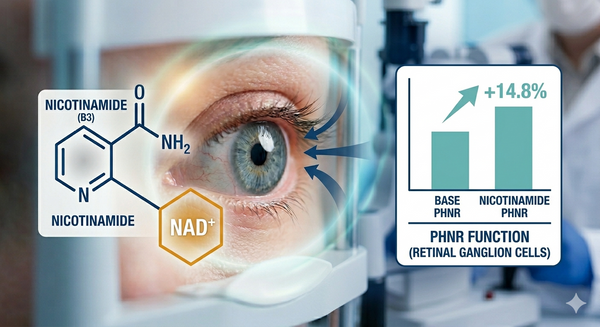
Over the past decade, researchers have increasingly viewed glaucoma as a neurodegenerative disease involving mitochondrial dysfunction and impaired cellular energy production. One molecule attracting particular attention is nicotinamide, also known as niacinamide or vitamin B3. It serves as a precursor to NAD+ (nicotinamide adenine dinucleotide), a molecule essential for cellular energy production and neuronal survival.
Preclinical research has been especially encouraging. In experimental glaucoma models, oral nicotinamide provided robust, dose-dependent protection of retinal ganglion cells, preserved visual function, and improved cellular metabolism. These findings led researchers to ask whether similar benefits could be achieved in people with glaucoma.
This study is one of the first to examine whether nicotinamide supplementation can improve how glaucoma patients actually experience their vision in daily life.
Study Design
Who Participated?
Researchers enrolled 58 patients diagnosed with primary open-angle glaucoma in Bucharest, Romania. Participants ranged from early-stage to severe glaucoma and continued their prescribed glaucoma medications throughout the study.
Treatment Protocol
All participants received:
- Nicotinamide 500 mg orally once daily
- Duration: 6 months
No changes were made to their existing glaucoma treatments during the study period.
Study Type
This was a:
- Prospective clinical study
- Single-arm intervention trial
- Non-randomized
- Non-placebo-controlled
Patients were evaluated before treatment and again after six months of supplementation.
How Researchers Measured Quality of Life
What Is the GQL-15 Questionnaire?
Instead of focusing only on eye pressure or retinal scans, researchers used the Glaucoma Quality of Life-15 (GQL-15) questionnaire.
The GQL-15 is specifically designed to measure how glaucoma affects daily activities. It evaluates four key areas:
Central and Near Vision
Measures difficulty with activities such as:
- Reading newspapers
- Recognizing faces
- Performing close-up tasks
Peripheral Vision
Measures the ability to:
- Detect objects approaching from the side
- Navigate crowded environments
- Avoid bumping into obstacles
Glare and Dark Adaptation
Assesses difficulty with:
- Night vision
- Driving after dark
- Adjusting between bright and dim lighting
Outdoor Mobility
Evaluates:
- Walking outdoors
- Crossing roads
- Navigating stairs and uneven surfaces
Higher scores indicate worse quality of life. Therefore, lower scores after treatment represent improvement.
Results: Nicotinamide Improved Multiple Aspects of Daily Vision
Overall Quality of Life Improved
After six months of supplementation, overall GQL-15 scores improved significantly.
- Mean improvement: 2.10 points
- Statistical significance: p < 0.0001
This suggests that patients experienced meaningful improvements in daily visual function.
Central and Near Vision Improved
Patients reported less difficulty with reading and other close-range visual tasks.
- Mean improvement: 2.16 points
- Statistical significance: p = 0.017
This finding is especially relevant because central vision supports many activities essential for independence and quality of life.
Peripheral Vision Improved
Peripheral vision showed one of the strongest improvements.
- Mean improvement: 2.66 points
- Statistical significance: p < 0.001
Patients reported greater ease detecting objects outside their direct line of sight and navigating crowded environments.
Glare and Dark Adaptation Improved the Most
The largest benefit occurred in glare and dark adaptation.
- Mean improvement: 5.24 points
- Statistical significance: p < 0.001
For many glaucoma patients, difficulty adjusting to darkness and coping with glare can be among the most frustrating symptoms. The magnitude of improvement observed in this domain was particularly noteworthy.
Outdoor Mobility Did Not Improve Significantly
The only area that did not show statistically significant improvement was outdoor mobility.
Researchers speculate that mobility may be influenced by many factors beyond vision, including physical fitness, balance, arthritis, and environmental conditions.
An Unexpected Finding: Eye Pressure Fell Slightly
Researchers also observed a small but statistically significant reduction in intraocular pressure.
After six months:
- Left eye pressure decreased by 0.53 mmHg
- Right eye pressure decreased by 0.36 mmHg
While modest, this finding is intriguing because most previous studies of nicotinamide focused on neuroprotection rather than pressure reduction.
The authors speculate that Nicotinamide may improve mitochondrial health within the trabecular meshwork—the drainage system of the eye—potentially improving fluid outflow and lowering pressure.
Why These Results Matter
What makes this study noteworthy is that it focuses on outcomes patients can actually feel.
Many glaucoma studies evaluate visual fields, retinal imaging, or eye pressure. While these measurements are important, they do not always capture how patients function in real life.
This study suggests that supporting retinal ganglion cell metabolism with nicotinamide may translate into improvements that patients notice directly, including:
- Better reading ability
- Improved peripheral awareness
- Easier adaptation to changing light conditions
- Greater confidence in daily activities
The findings also reinforce a growing scientific theory that glaucoma is not merely a disease of elevated eye pressure. It may also be a disease of impaired cellular energy metabolism, making nutritional approaches such as nicotinamide an important area of future research.
Important Limitations
While encouraging, the study has several limitations.
No Placebo Group
All participants received nicotinamide, making it impossible to completely exclude a placebo effect.
Not Randomized
Participants were not randomly assigned to treatment groups.
Single-Center Study
The research was conducted at a single ophthalmology clinic in Romania.
Subjective Outcomes
The primary endpoint was a quality-of-life questionnaire rather than objective measures such as visual field progression or retinal imaging.
Because of these limitations, the findings should be viewed as promising but preliminary. Larger randomized placebo-controlled trials will be needed to determine whether nicotinamide truly improves glaucoma outcomes.
Bottom Line
For years, glaucoma treatment has focused almost exclusively on lowering eye pressure. This study points to another possibility: improving the health and energy production of retinal ganglion cells themselves.
After six months of daily nicotinamide supplementation, glaucoma patients reported meaningful improvements in several aspects of daily visual function, particularly peripheral vision and adaptation to low-light conditions. Although larger studies are needed, the findings add to a growing body of evidence suggesting that nicotinamide may become an important adjunctive strategy in glaucoma care.
Study Reference
Nicola CA, Marinescu MC, Firan AM, et al. Changes in Quality of Life Among Glaucoma Patients Following Six Months of Niacinamide Supplementation. Nutrients. 2025;17(17):2775. DOI: 10.3390/nu17172775.
Science-informed glaucoma supplement with 500 mg Nicotinamide & 120 mg Ginkgo Biloba. Be first to know when it's available.